Independent companion guide
Software for Use
A structured guide to the central ideas in Larry Constantine and Lucy Lockwood's book on usage-centered design: role models, essential use cases, task organization, interface architecture, abstract prototypes, and evaluation.
What This Guide Covers
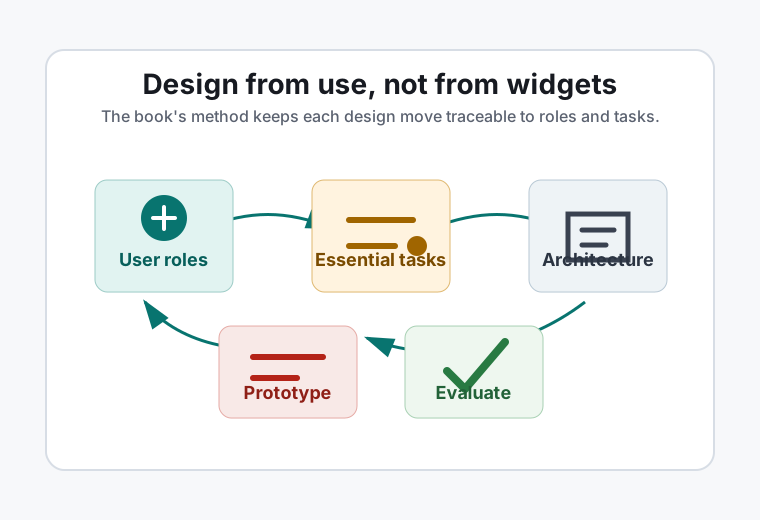
Software for Use presents a practical design method for interactive software. The method starts from what people are trying to accomplish with a system, describes those uses at an essential level, and carries the models forward into interface structure and evaluation.
This site is a companion in original prose. It explains the topics and gives working templates, examples, and checklists, but it is not a substitute for the book.
Recommended Reading Path
Core Principles
Use before users as profiles
The method does not ignore people, but it treats their participation in work as the unit of design. A single person may play several roles, and one role may be shared by many people.
Essential before concrete
Early models deliberately avoid screen controls, page layouts, and implementation details. That abstraction preserves design freedom while requirements are still being understood.
Models before screens
The interface should be derived from role and task structure. Screens are later expressions of the model, not the first place the team negotiates requirements.
Trace decisions to use
A feature, command, workspace, or navigation path should be explainable by the role it serves and the task intention it supports.
Sources and Scope
- Larry Constantine and Lucy Lockwood, Software for Use: A Practical Guide to the Essential Models and Methods of Usage-Centered Design, Addison-Wesley, 1999.
- Usage-centered design overview, used to confirm the high-level description of the method and its model families.
- Larry Constantine biography, used to confirm publication context and terminology.